
Melton Wool 101: The Science Behind our Coats

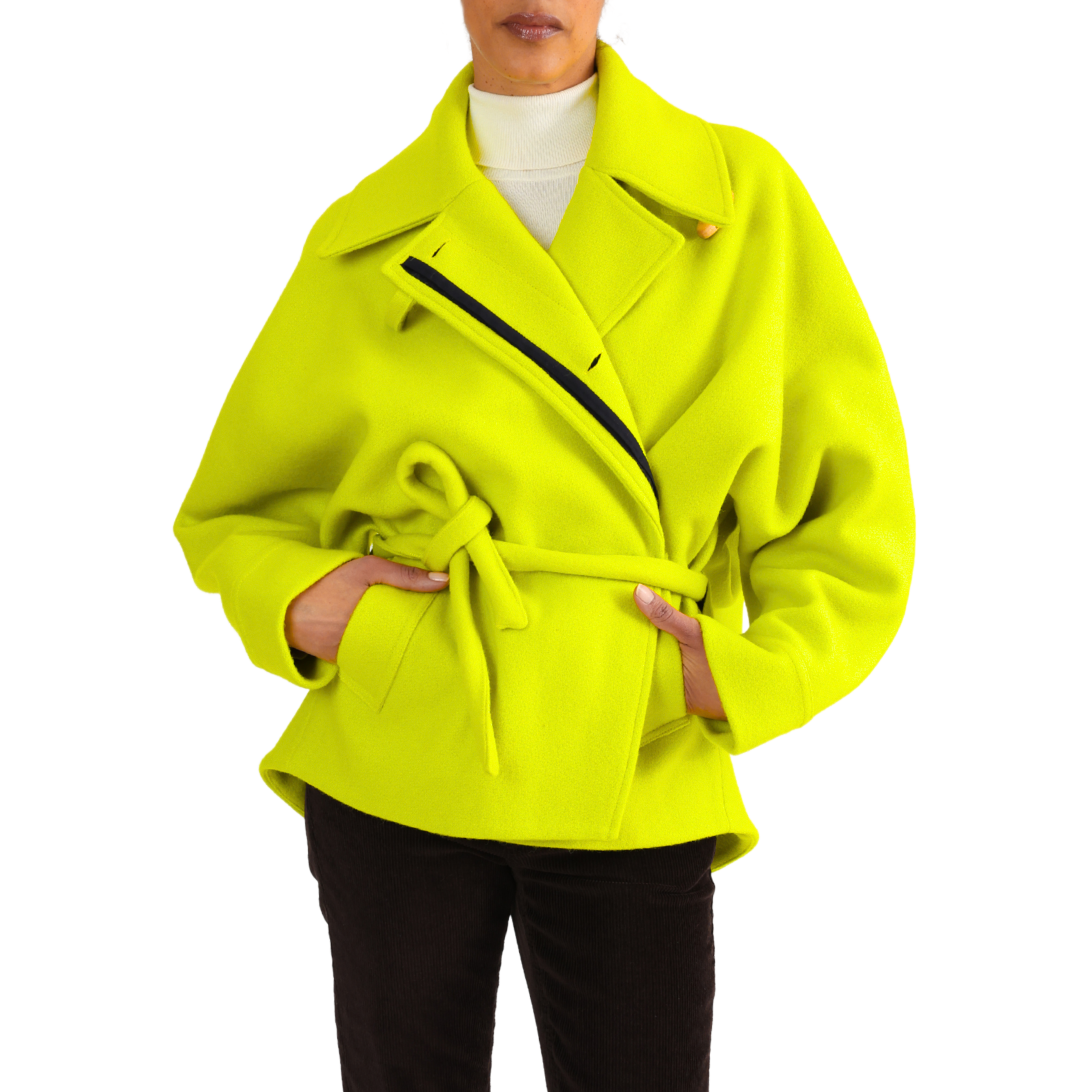
Run your hand across a SteMargScot coat and you might notice something unusual. Our luxurious fabric contains no visible thread or weave, just a smooth, dense surface that feels unified rather than classically woven.
The finish of our wool begins as ordinary yarn. The raw fleece is scoured, spun into yarn, and woven on a loom like any other fabric. What happens next is what sets it apart. The woven cloth is deliberately shrunk until the individual fibres lock together, permanently, at a microscopic level, into one dense material. That finish is called felted wool (or melton wool), and the science and history behind it is actually older than the loom itself.
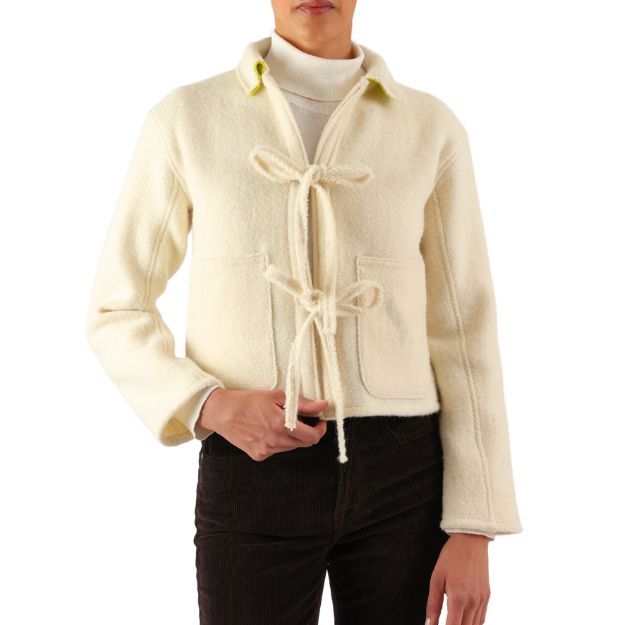
Our coats, including The Frankie, The Theodore, The Bowie, The Baby Bowie and The Taylor, are cut from 100% felted wool Melton, woven in small batches by a family-owned British mill. Here is why we would not make them from anything else.
From Fleece to Cloth: What Is Felted Wool?
Every felted wool coat starts as raw fleece, sheared from the sheep. The fleece is scoured to remove grease, dirt, and lanolin, then carded to untangle and align the fibres into a soft rope, ready to be spun into yarn. That yarn is woven into cloth on a loom, exactly as any other woollen fabric would be. Up to this point, felted wool and a plain woollen tweed are nearly identical.
The difference happens in finishing. The woven cloth is deliberately shrunk and thickened with moisture, heat, and friction until the fibres lock together into one dense, unified material. Textile makers call this finishing process fulling or milling. At this stage, the cloth shrinks by 10 to 25 percent, producing a smooth, tightly finished fabric that is light, warm, and relatively weatherproof (Britannica).

Image by The Wool Room
Every wool fibre is covered in microscopic, overlapping scales that all point in one direction, from root to tip, like shingles on a roof. When the fibre gets wet, warm, and agitated, those scales catch against each other, creating a powerful and durable lock.
This process is known as milling. The Woolmark Company describes milling as a controlled wash that consolidates the fabric, letting the yarns swell and the fibres bloom across the surface until the weave disappears.
The next step is napping and shearing, where the surface is brushed, then trimmed close for a smooth, uniform finish.
Spotting the Real Thing: Wool Felt vs. Acrylic Felt

Image by Cloud Craft
Felt vs. Felted Wool: What's the Difference?
One quick distinction, because we know the terminology can get a little confusing!
Felt isn't a specific fibre. It's a fabric-making process. Felt can be made from different fibres, including wool and acrylic. The inexpensive sheets commonly found in craft stores, for example, are often made by bonding loose synthetic fibres together without weaving them first. The result depends on both the fibres used and how they're processed.
Felted wool, on the other hand, starts as woven wool fabric. The fabric is then exposed to moisture, heat and agitation, causing the wool fibres to interlock and the weave to become denser. The result is a durable, structured fabric that retains the character of the original woven cloth.
How to Tell the Difference
Not all felt is created equal. Here are a couple of things to look for:
-
Fibre content: Check the label. Felt can be made from wool, acrylic or a blend of fibres, so the word felt alone doesn't tell you what you're buying.
-
Texture and structure: Wool felted fabric often has a rich, textured feel and a substantial structure. Synthetic craft felt tends to be thinner and more uniform, although this can vary depending on how it's made.
-
Price: Quality wool fabric generally costs more to produce than synthetic alternatives, so unusually low prices are worth investigating.
The key takeaway? Felt describes how fibres are bonded together, not what those fibres are made of. Understanding both the fibre content and the production process makes all the difference.
Quick History Lesson: A Craft Older Than the Loom
Felting is one of humanity's oldest textile techniques, older than both weaving and knitting. The earliest preserved evidence of felt production is a wall covering found in present-day Turkey that dates as far back as 6500 BC (Montessori Handiwork).

Image by Pelskes Vilt
Independently, nomadic peoples of the Central Asian steppe, in regions that are now Mongolia, Kazakhstan, and the Altai Mountains, developed felting as a foundational craft from around 6000 BC onward.
Felt required no loom and no complex tools, only wool, water, heat, and pressure, which made it ideal for a mobile way of life. It became the covering for the yurt, the portable round tent still used across the Eurasian steppe today, as well as clothing, boots, and blankets.
Felted Hats: An Ancient Accessory
The felting tradition that produced yurts and blankets also produced some of the earliest known hats. Archaeologists excavating Iron Age burial sites in Siberia, dated to between the seventh and second centuries BC, recovered felt clothing, wall hangings, and headwear preserved in permafrost.
The oldest known felt hat, found in one of these tombs, is dated to around 600 BC, evidence that Central Asian nomads, including the Scythians, were shaping felt into fitted hats well over two thousand years ago (Encyclopaedia Iranica).

Image by Agnoulita Hats
Back to Melton: The Fabric of Our Coats
The felted wool we use is called Melton and it begins as a dense twill of strong wool yarns, then fulled so heavily the twill pattern vanishes completely (Wikipedia). Napped and closely sheared, Melton is widely considered the most weatherproof of all woollen cloths and naturally perfect for SteMargScot!
Felted Wool vs. Other Wool Fabrics

Image by Woolmaven
Not all wool is created equal, and the split starts before the loom, in how the yarn itself is spun.
Worsted wools, like suiting, are spun from long fibres aligned in parallel before spinning. That process produces a smooth, dense, lightweight yarn, and a finished cloth with the weave left visible.
Woollen wools, like Melton, are spun from shorter fibres that stay jumbled rather than aligned. The chaotic alignment gives woollen cloth its characteristic loft, warmth, and natural fuzziness.
Felted wool closes those air gaps entirely. Because the fibres are physically locked together, the fabric is dramatically more windproof than any open weave or knit. As well, cut edges do not fray easily, since there are no loose threads left to unravel.
Why Felted Wool Belongs in Outerwear
Felted wool is prized in coats and accessories for:
-
Wind resistance: the compacted structure blocks wind that slips through knits and open weaves
-
Water repellency: wool's waxy fibre coating naturally sheds rain and snow, and the dense finish slows any soak-through
-
Warmth without bulk: millions of tiny air pockets trapped between crimped fibres hold in body heat
-
Durability: felted coats resist abrasion, hold their shape, and routinely last for decades
Built to Be Worn, Made to Last

Felted wool is what happens when centuries of craft meet a fibre made by nature for the outdoors. Every SteMargScot coat carries that lineage, with a hearty felted Melton shell that stands up to Canadian winters and a silky Tencel™ lining that breathes from the inside.
Explore our new fall collection and wear a fabric with a thousand years of proof behind it. If you would like to dig deeper into wool's remarkable properties, visit The Woolmark Company or the International Wool Textile Organisation.
